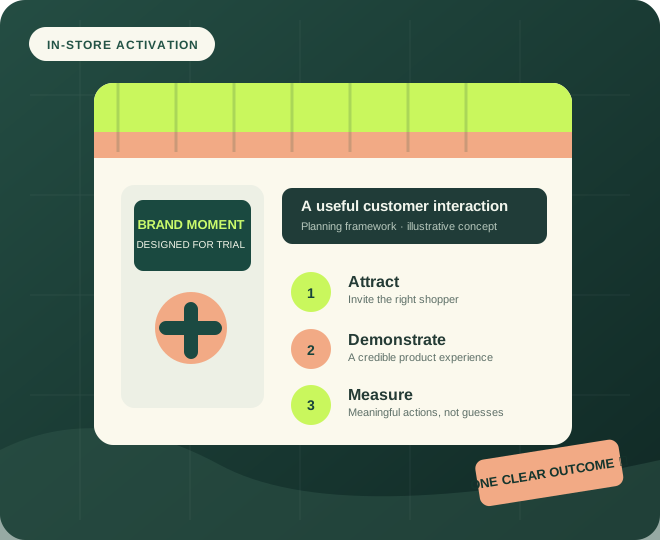
Primary action: Discuss a sampling campaign
Handing out a sample is an activity. Getting the right consumer to understand a product, know where to find it and take a next step is a campaign. We plan sampling around that distinction, especially when sampling sits beside a retail shelf or forms part of a wider brand launch.
Design the trial around a buying moment
A premium drink may be served as an invitation to explore a new retail space. A food product might benefit from a tasting near a participating stockist. A technology product might need a guided demonstration rather than an unstaffed giveaway. We choose a format only after the target audience and the desired action are clear.
What needs to be in the sampling plan?
- Audience and venue: Which shoppers matter, why they will be there, retailer permissions and the approved campaign footprint.
- Product and handling: Stock quantity, batch control, cold storage, equipment, allergen information, food-safety obligations and waste handling where relevant.
- Crew: Training scripts, an escalation contact, queue management, breaks and consistent handling of product questions.
- Conversion: Signposting to the right store/shelf, permitted offer redemption, opt-in data capture where lawful and practical customer education.
- Replenishment: A realistic peak-demand estimate, daily stock checks, contingency and end-of-day reconciliation.
- Measurement: Samples offered and actually accepted, interactions, store visits or redemption data when available, plus limitations on attributing purchases.
Small test before a national programme
Where budget and retailer approvals allow, a controlled first-location test can expose practical issues: the product may require longer interaction, stock access may be constrained or customers may need a clearer call to action. Use those observations to improve the programme before extending the rollout. The purpose is operational learning, not a claim of statistically proven uplift from a one-day test.
Working alongside existing agencies
If you already have a creative or shopper-marketing lead, the activation can be scoped as a specific on-the-ground workstream. Agree brand ownership, approvals, retailer relationships and reporting responsibilities so that teams do not duplicate work.
Learn about in-store activations and multi-store rollouts.
Tell us the product, retailers, cities, dates and required sampling volume. Send your brief and we will identify what needs confirming before a formal proposal.
What makes the sampling plan commercially usable
A sample is only useful when it reaches the intended audience and the campaign can explain what happened afterwards. Separate stock distributed from meaningful product trial.
- Sample arithmetic: define a defensible target per hour, reserve stock for peaks and identify what becomes waste.
- Experience design: make the difference between an eligible shopper, someone accepting a sample and someone asking a product question explicit.
- Operational control: batch handling, allergens where food is involved, temperature if relevant and approved product claims.
- Measurement: count completed samples and eligible interactions independently; redemption or sales need their own data source.
The buyer decision: If the product needs special handling, agree its restrictions before booking a location or pricing crew numbers.