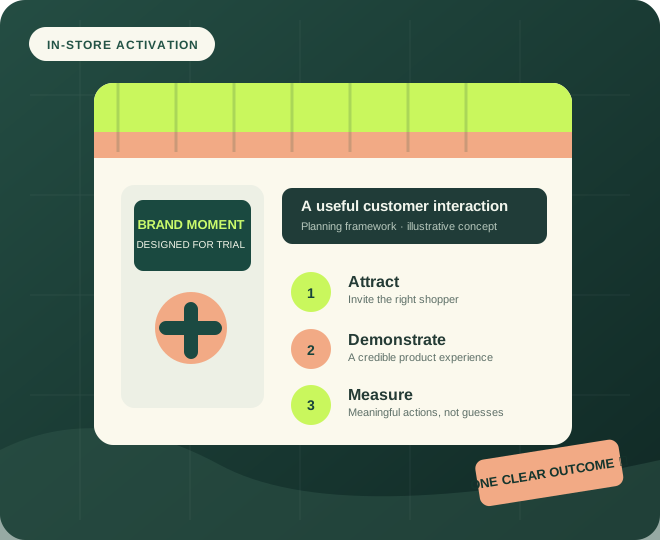
Primary action: Send an in-store campaign brief
A good in-store activation is not simply a stand that looks attractive in a photograph. It works around real trading patterns: staff cannot block access, replenishment cannot interrupt sales, and the activity must make sense for a shopper who is already there for another reason.
Start with the customer decision
Is the product unfamiliar? Does it need to be tasted, handled or compared? Does a premium launch require an elevated hospitality experience? Begin with that barrier and choose a format that removes it. Typical possibilities include guided trial sessions, branded drink or sampling counters, product storytelling zones, and advisor-led demonstrations. The right answer depends on retailer rules, audience and budget—not a standard package.
Four operational decisions that change a campaign
- Store authorisation and floor plan. Ask for a named retail decision-maker, access agreement, permitted footprint, hours, electricity/food arrangements and any signage restrictions. Do not assume permission because the public can enter the store.
- What the shopper encounters. Design a short, legible invitation, an accessible interaction, a brand-appropriate takeaway and a clear next step. An activation for a watch launch should not look or operate like a supermarket tasting.
- The team and stock. Determine live staff skills, delivery cover, shift overlap, inventory, downtime and peak-hour replenishment. Check any age or allergen controls before approving a menu.
- Measurement. Record conversations, trials, sign-ups and location notes separately. Where point-of-sale information is available, agree its owner and limitations before treating it as attributed campaign impact.
From a flagship store to a repeatable model
A London flagship may establish the creative system, but regional rollouts require their own site and staffing reviews. For businesses expanding beyond one address, see multi-store retail campaigns. If trial is the main objective, see product sampling campaigns.
Information needed for a quote
Provide the retailer name, proposed store locations, floor-plan/access status, dates, operating hours, expected attendance, staffing restrictions, brand guidelines, equipment, stock and preferred performance measures. A useful quotation should separate management, creative, build, staffing, stock and logistics rather than bury each line in a single unexplained total.
Planning a launch or retail campaign? Discuss the activation with the number of stores, your objectives and a working budget range.
What a retailer-ready activation plan contains
A live store is a trading environment, not an empty event space. The usable footprint, trading priorities and store manager approval all shape the idea before any visual is produced.
- Footprint and access: the retailer-approved position, dimensions, queue boundaries, safe access and permitted operating hours.
- Product demonstration: who is authorised to demonstrate, what must be explained, how stock is replenished and when a demonstration must stop.
- Crew handover: arrival instructions, opening checks, escalation contacts and the end-of-day handback to the store.
- Evidence: interactions, qualified conversations and any retailer-supplied sales measures kept in separate reporting columns.
The buyer decision: Ask whether the agency has allowed for opening-hour restrictions, not simply whether it has an appealing stand concept.