Primary action: Discuss a pop-up activation
A pop-up can introduce a product, create a focused place for trial or give a wider campaign a tangible home. But temporary retail formats have real constraints: shop opening hours, permitted installations, insurance, public access, storage, staffing, fit-out sign-off and de-rig all affect what is deliverable.
Choose the format to match the brief
- In-store branded moment: compact, integrated into an existing retail space and designed to make the buying decision easier.
- Shopping-centre or public-space pop-up: location-led and subject to management permission, safety, power and public flow.
- Launch-day environment: a more controlled experience for buyers, press or invited guests, with event production and retail operation coordinated.
- Touring pop-up: reusable creative that can travel across approved locations; particularly useful for multi-store or national campaigns.
What the creative brief should settle
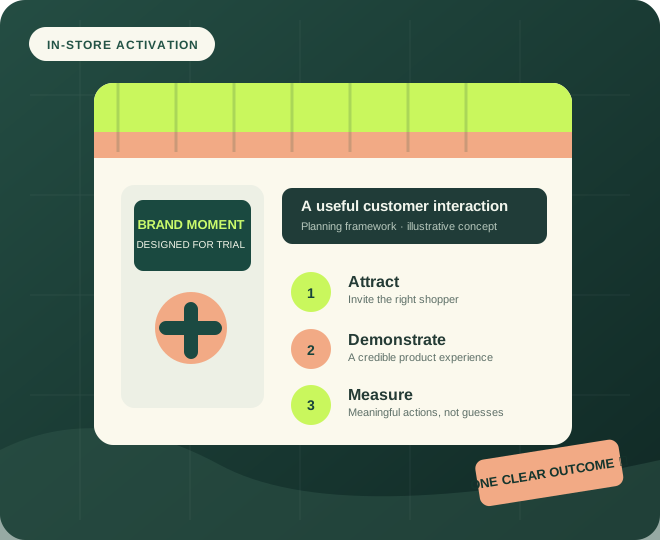
The agency must know whether a customer is meant to sample, discover, purchase, book a demonstration or register interest. That decision determines where staff stand, whether a product needs secure storage, how queues are handled, and what happens after the interaction.
Budget and risk planning
Pop-up costing should distinguish creative, fabrication, venue/permission costs, transport, staffing, stock, insurance, accessibility, electricity, waste and photography. Before promising a design, establish the actual space rules and the contractor/venue responsibilities. A 'simple' build can become costly if lift access or overnight removal was not considered.
Reporting that earns its place
Count interactions that genuinely occurred. If a QR code or voucher is used, define what counts as redemption. If the campaign runs in a trading store, confirm whether transaction metrics can actually be supplied before referring to sales uplift.
Explore product sampling or multi-store rollouts if the activation needs to travel.
Tell us where the pop-up would operate and what you want visitors to do. Send a brief.
A credible pop-up decision starts with the licence
Visual mock-ups alone do not determine whether a pop-up is viable. In many locations, the contract, permitted activities and removal obligations control the real programme.
- Space: confirm the precise footprint, permitted use, access hours and whether fixtures are freestanding or fixed.
- Public safety: define queue capacity, accessibility, security, trip hazards and any electrical or food permissions.
- Commercial intent: decide whether the visitor should trial, book, register or purchase, and build the layout around that action.
- Handover: allocate responsibility for fit-out sign-off, storage, cleaning, waste and damage inspection.
The buyer decision: For multi-site pop-ups, test one location before assuming the same fixture will fit every subsequent venue.
When a touring pop-up is the wrong option
A modular pop-up may seem economical if it can travel between six locations. But a single site with narrow loading access, a shorter permitted window or a ban on amplified sound may require a different version. Before designing all six, develop a maximum footprint, a reduced-footprint alternative and a checklist for which elements are mandatory.
This helps the brand make a commercially important decision early: reuse one dependable kit, pay to adapt it, or restrict the campaign to locations that can support the original concept.