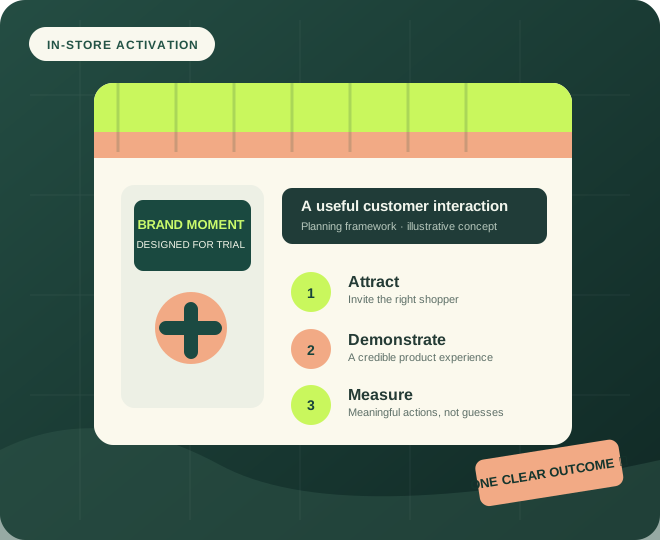
A frequently repeated number—people reached—may be the least useful outcome for an activation. A brand needs to know how many customers had a meaningful interaction and what happened afterwards.
What this service is designed to solve
Choose a primary conversion event before selecting the installation. Depending on the brief, it might be verified product trials, completed demonstrations, opt-in registrations or tracked offer redemptions.
The work to scope before a quotation
Measurement tree; definition of a qualified interaction; daily site-level scorecard; consent wording requirements; attribution limitations; an end-of-campaign insight document.
To build a dependable proposal, start with the intended audience, the target date or date range, the campaign format, the number of locations and a realistic budget bracket. Where the client already controls a venue, store, supplier or piece of equipment, that can materially change the plan. Where nothing is booked yet, the first phase should validate those assumptions rather than describe them as secured.
The operational reality
Retailer sales and e-commerce outcomes may not be available to the activation team. Where attribution is incomplete, report the uncertainty explicitly.
The commercial proposal should make clear who approves the concept, who signs off the site and which activities are delivered by specialist partners. We separate fixed production elements from location-dependent variable costs; that keeps the client in control if the scope changes before launch.
A sensible measurement plan
Use a matched control or agreed comparison period if the client wants to estimate incremental lift; do not turn correlation into a promise of causation.
Before launch, agree precisely what counts as an engagement, a qualified enquiry, a product trial or a conversion. Keep opt-in customer data and anonymised activity counts distinct. The final report should identify both observed outcomes and evidence gaps. This is more useful for a repeat programme than a single unqualified headline number.
What to include in the initial enquiry
- Locations and permissions: what is confirmed, preferred or still awaiting approval.
- Audience and objective: who needs to act and what action matters.
- Physical footprint: available floor area, power, storage and access conditions.
- People and production: likely staff roles, creative assets, product stock and specialist requirements.
- Dates and budget: firm deadlines, flexibility, buying authority and intended spending range.
- Success measure: how an outcome will be captured and who owns customer follow-up.
Frequently asked question
Can you prove incremental sales from a retail activation?
Only when the brand and retailer provide appropriate data and the measurement method is agreed before launch.
Start with a real brief
Share the campaign objective and the operating constraints. We will distinguish what is possible from what still needs supplier or site verification before preparing a detailed proposal. Discuss a campaign.
An activation measurement plan with fewer misleading numbers
Decide the data definitions before the first site opens. This is particularly important if the brand wants comparisons across different retail locations.
- Reach: define whether the figure is location footfall, people passing the stand or actual visitors; these are not interchangeable.
- Engagement: define a minimum meaningful interaction, not every glance or leaflet taken.
- Action: record samples completed, qualified consultations, opt-ins and transactions as separate metrics.
- Attribution: identify what the retailer or client can actually provide and label any estimate rather than presenting it as observed sales.
The buyer decision: An honest report that explains incomplete data is more useful than an impressive-looking dashboard with invented impact.