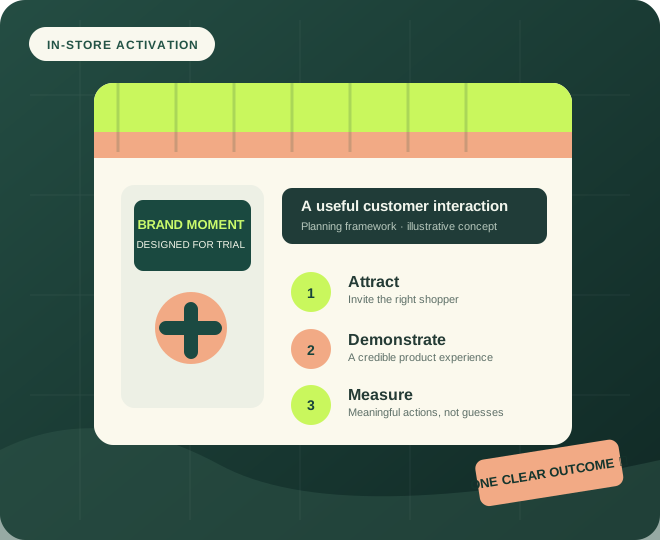
Food and beverage sampling works when it creates a clean and memorable first taste without slowing the retail operation. The smallest details—cooling, allergies, queue layout and waste collection—often determine whether the idea can scale.
What this service is designed to solve
Formats can include staffed tasting stands, packaged-sample handouts, flavour comparisons, new-product launches and concession-style experiences.
The work to scope before a quotation
Approved product and allergen information; sampling quantities and waste plan; food-handling responsibilities; equipment and cold-chain assumptions; staffing model; reporting by store and day.
To build a dependable proposal, start with the intended audience, the target date or date range, the campaign format, the number of locations and a realistic budget bracket. Where the client already controls a venue, store, supplier or piece of equipment, that can materially change the plan. Where nothing is booked yet, the first phase should validate those assumptions rather than describe them as secured.
The operational reality
A valid food-safety and allergens plan is essential. Local retail rules, liability requirements and supplier availability determine whether a proposed format is feasible.
The commercial proposal should make clear who approves the concept, who signs off the site and which activities are delivered by specialist partners. We separate fixed production elements from location-dependent variable costs; that keeps the client in control if the scope changes before launch.
A sensible measurement plan
Report eligible samples served, opted-in follow-up and store feedback separately from any claimed sales lift.
Before launch, agree precisely what counts as an engagement, a qualified enquiry, a product trial or a conversion. Keep opt-in customer data and anonymised activity counts distinct. The final report should identify both observed outcomes and evidence gaps. This is more useful for a repeat programme than a single unqualified headline number.
What to include in the initial enquiry
- Locations and permissions: what is confirmed, preferred or still awaiting approval.
- Audience and objective: who needs to act and what action matters.
- Physical footprint: available floor area, power, storage and access conditions.
- People and production: likely staff roles, creative assets, product stock and specialist requirements.
- Dates and budget: firm deadlines, flexibility, buying authority and intended spending range.
- Success measure: how an outcome will be captured and who owns customer follow-up.
Frequently asked question
Can sampling operate across several retailers?
Potentially, but each retailer or site has its own permissions, trading requirements and operational conditions.
Start with a real brief
Share the campaign objective and the operating constraints. We will distinguish what is possible from what still needs supplier or site verification before preparing a detailed proposal. Discuss a campaign.
Food and drink require their own operating workstream
Food-based experiences add storage, ingredient control, waste and food-safety responsibilities. These belong alongside—not beneath—the creative brief.
- Menu and audience: allergens, ingredient labelling, whether the venue permits on-site preparation and any restrictions on promotion.
- Equipment: water, chilled storage, power, food-safe service surfaces and cleaning requirements.
- Volume: planned servings per hour, replenishment limits, stock reserves and contingency if footfall differs.
- Brand integration: cups, cart artwork and staff presentation must pass artwork approval without compromising legibility or food information.
The buyer decision: Illustrative campaign quantities are planning inputs, not proof of drinks actually served or purchases generated.