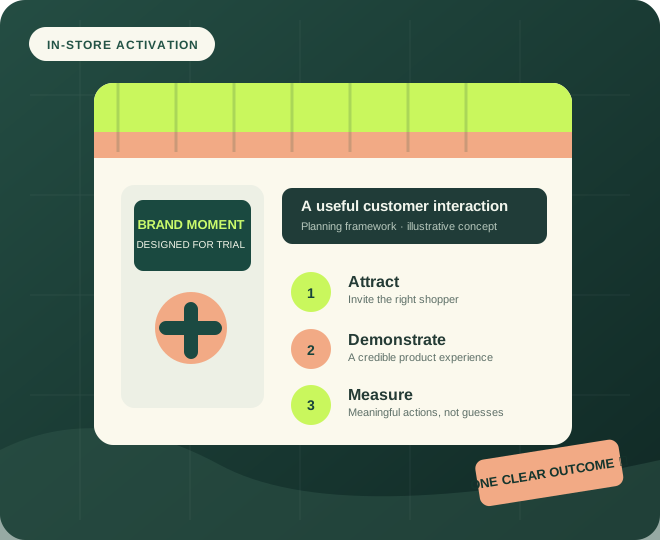
Ideas are only useful when they fit a real customer behaviour and a real retail environment. An interactive format that blocks a shop aisle or requires impossible stock access should be redesigned, not squeezed into the venue.
What this service is designed to solve
Examples include a guided trial bar, timed demo stage, discovery station, assisted comparison, local partner pop-up, bespoke tasting, launch-week appointment programme and a modular travelling counter.
The work to scope before a quotation
For each concept, specify target shopper, one desired action, staff requirement, equipment footprint, stock assumptions, accessibility and reporting method.
To build a dependable proposal, start with the intended audience, the target date or date range, the campaign format, the number of locations and a realistic budget bracket. Where the client already controls a venue, store, supplier or piece of equipment, that can materially change the plan. Where nothing is booked yet, the first phase should validate those assumptions rather than describe them as secured.
The operational reality
These are illustrative concepts, not documented Pearl Lemon client case studies, confirmed installations or guaranteed outcomes.
The commercial proposal should make clear who approves the concept, who signs off the site and which activities are delivered by specialist partners. We separate fixed production elements from location-dependent variable costs; that keeps the client in control if the scope changes before launch.
A sensible measurement plan
Choose one hero interaction and one secondary follow-up; excessive features can reduce clarity and make delivery harder to manage.
Before launch, agree precisely what counts as an engagement, a qualified enquiry, a product trial or a conversion. Keep opt-in customer data and anonymised activity counts distinct. The final report should identify both observed outcomes and evidence gaps. This is more useful for a repeat programme than a single unqualified headline number.
What to include in the initial enquiry
- Locations and permissions: what is confirmed, preferred or still awaiting approval.
- Audience and objective: who needs to act and what action matters.
- Physical footprint: available floor area, power, storage and access conditions.
- People and production: likely staff roles, creative assets, product stock and specialist requirements.
- Dates and budget: firm deadlines, flexibility, buying authority and intended spending range.
- Success measure: how an outcome will be captured and who owns customer follow-up.
Frequently asked question
Can you develop a concept that fits our brand guidelines?
Yes, we can scope concept development after reviewing brand assets, site constraints, goals and production budget.
Start with a real brief
Share the campaign objective and the operating constraints. We will distinguish what is possible from what still needs supplier or site verification before preparing a detailed proposal. Discuss a campaign.
Compare two concepts against the same objective
Imagine a brand launching an unfamiliar kitchen product. An oversized display may stop people, but a five-minute demonstration lets shoppers understand how it works. If the real objective is purchase consideration, the demonstration should be evaluated against qualified conversations and questions answered rather than overall display footfall.
For a high-frequency food product, the opposite may be sensible: a quick, accessible tasting can create useful product trial without a long explanation. Both concepts can fit an activation brief, but only one should be selected after the venue constraints, operating hours, stock and reporting requirements are known.