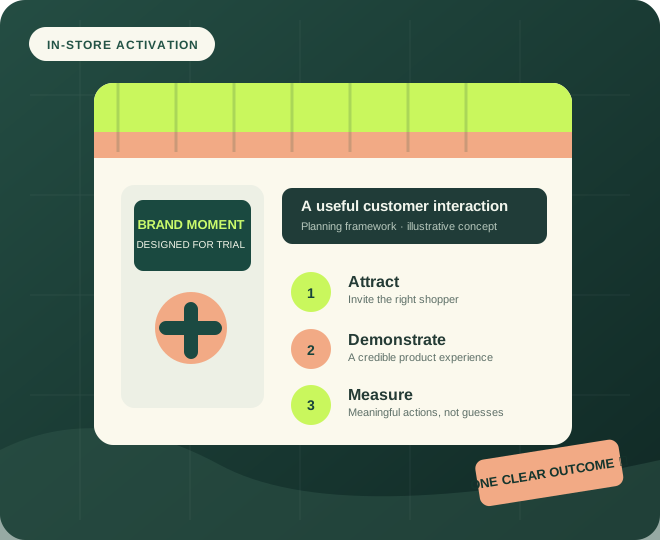
A customer-facing activation depends heavily on the first thirty seconds of conversation. Staff must know the product, what is permitted, how to approach shoppers respectfully and how to escalate questions they cannot answer.
What this service is designed to solve
Staffing may cover greeters, demonstrators, sampling hosts, queue management and team leads. Specialist roles are verified rather than implied as an automatically available roster.
The work to scope before a quotation
Role and competency matrix; training script; brand-language guidance; escalation map; shift and break plan; arrival and attendance checks; performance reporting template.
To build a dependable proposal, start with the intended audience, the target date or date range, the campaign format, the number of locations and a realistic budget bracket. Where the client already controls a venue, store, supplier or piece of equipment, that can materially change the plan. Where nothing is booked yet, the first phase should validate those assumptions rather than describe them as secured.
The operational reality
Staff must be appropriately insured, briefed and legally eligible for their duties. Some products require specialist qualifications or approvals.
The commercial proposal should make clear who approves the concept, who signs off the site and which activities are delivered by specialist partners. We separate fixed production elements from location-dependent variable costs; that keeps the client in control if the scope changes before launch.
A sensible measurement plan
Use customer experience checks and meaningful engagement measures, not only total shifts filled.
Before launch, agree precisely what counts as an engagement, a qualified enquiry, a product trial or a conversion. Keep opt-in customer data and anonymised activity counts distinct. The final report should identify both observed outcomes and evidence gaps. This is more useful for a repeat programme than a single unqualified headline number.
What to include in the initial enquiry
- Locations and permissions: what is confirmed, preferred or still awaiting approval.
- Audience and objective: who needs to act and what action matters.
- Physical footprint: available floor area, power, storage and access conditions.
- People and production: likely staff roles, creative assets, product stock and specialist requirements.
- Dates and budget: firm deadlines, flexibility, buying authority and intended spending range.
- Success measure: how an outcome will be captured and who owns customer follow-up.
Frequently asked question
Can you staff 20 stores in one weekend?
We can assess staffing feasibility and propose a phased coverage plan after dates, locations, roles and shift requirements are confirmed.
Start with a real brief
Share the campaign objective and the operating constraints. We will distinguish what is possible from what still needs supplier or site verification before preparing a detailed proposal. Discuss a campaign.
The staffing model is part of the strategy
An excellent stand with an inconsistent crew can produce unreliable brand experiences. Staffing should be designed around actual operating hours and customer complexity.
- Briefing: product knowledge, approved language, escalation scripts and role-play for common objections.
- Coverage: shift length, breaks, travel time, peak-period allocation and replacements.
- Compliance: right-to-work and site access checks by the responsible employer or supplier.
- Quality checks: structured observations and location reports rather than merely counting shifts filled.
The buyer decision: A lower daily staff rate is not a saving if it requires extra supervision, travel or correction work.